
Vitamins Ascorbic Acid, Riboflavin, Pyridoxine and Thiamine Analyzed using a pH Gradient – AppNote
May 21, 2012
/
/
/
Separation of Ascorbic Acid, Riboflavin, Pyridoxine, & Thiamine
Using a pH Gradient
This LCMS compatible Method shows excellent Separation and Retention for all four analytes. If the analysis were done by Reversed Phase, LCMS incompatible ion pair agents would likely be required to get this type of separation.
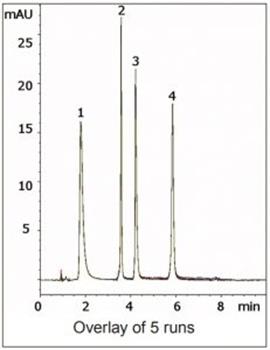
Ascorbic Acid was found to have better Retention near neutral pH but Thiamine was retained too strongly under these conditions. Therefore a pH gradient was used in which the acidity of the Mobile Phase increases as well as the Water content. The Method is reliable and Robust with respect to analyte Retention and Peak shape, as the overlay of five consecutive runs in the Figure demonstrates.
Column: Cogent Diamond Hydride™, 4 µm, 100 Å
Catalog No.: 70000-7.5P
Dimensions: 4.6 x 75 mm
Mobile Phase:
Post Time: 3 minutes
Injection vol.: 1 µL
Flow rate: 1.0 mL / minute
Detection: UV @ 266 nm
Sample Preparation: Mix of 300 mg / L Ascorbic Acid, 5 mg / L Riboflavin, 100 mg / L Pyridoxine, 20 mg / L Thiamine in 50% 10 mM Ammonium Formate / 50% Acetonitrile diluent. Solution was filtered through 0.45 µm Nylon Syringe Filter (MICROSOLV Tech Corp.). Peak identities were confirmed by individual standards.
t 0 : 0.9 minutes
Note: The word “vitamin” was originally spelled “vitamine” when it was first coined by biochemist Casimir Funk. It was derived from the words “vital” and “amine” because it was believed at the time that all vitamins were chemical amines. The “e” was dropped from the word when it was discovered that this is not the case.

Attachment No 164 pH Gradient to Separate Vitamins pdf 0.6 Mb Download File
Using a pH Gradient
This LCMS compatible Method shows excellent Separation and Retention for all four analytes. If the analysis were done by Reversed Phase, LCMS incompatible ion pair agents would likely be required to get this type of separation.
Ascorbic Acid was found to have better Retention near neutral pH but Thiamine was retained too strongly under these conditions. Therefore a pH gradient was used in which the acidity of the Mobile Phase increases as well as the Water content. The Method is reliable and Robust with respect to analyte Retention and Peak shape, as the overlay of five consecutive runs in the Figure demonstrates.
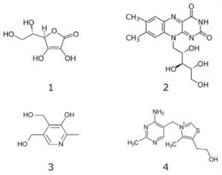
Peaks: 1. Ascorbic Acid, 2. Riboflavin, 3. Pyridoxine, 4. Thiamine
Method ConditionsColumn: Cogent Diamond Hydride™, 4 µm, 100 Å
Catalog No.: 70000-7.5P
Dimensions: 4.6 x 75 mm
Mobile Phase:
- A: DI Water / 10mM Ammonium Formate / 0.05% Formic Acid (pH 3.5)
- B: 95% Acetonitrile / 5% 10mM Ammonium Formate (pH 6.5)
| Time (minutes) | %B |
|---|---|
| 0 | 100 |
| 1.5 | 100 |
| 4 | 30 |
| 6 | 30 |
| 7 | 100 |
Post Time: 3 minutes
Injection vol.: 1 µL
Flow rate: 1.0 mL / minute
Detection: UV @ 266 nm
Sample Preparation: Mix of 300 mg / L Ascorbic Acid, 5 mg / L Riboflavin, 100 mg / L Pyridoxine, 20 mg / L Thiamine in 50% 10 mM Ammonium Formate / 50% Acetonitrile diluent. Solution was filtered through 0.45 µm Nylon Syringe Filter (MICROSOLV Tech Corp.). Peak identities were confirmed by individual standards.
t 0 : 0.9 minutes
Note: The word “vitamin” was originally spelled “vitamine” when it was first coined by biochemist Casimir Funk. It was derived from the words “vital” and “amine” because it was believed at the time that all vitamins were chemical amines. The “e” was dropped from the word when it was discovered that this is not the case.
Attachment No 164 pH Gradient to Separate Vitamins pdf 0.6 Mb Download File